 Block machine Molds – Brick Machine Moulds Factory

Learn where stress builds up in a concrete block machine mould, how to detect it before it cracks a cavity, and how manufacturers relieve or design around it.

What Causes Stress in Concrete Block Machine Moulds — And What You Can Actually Do About It
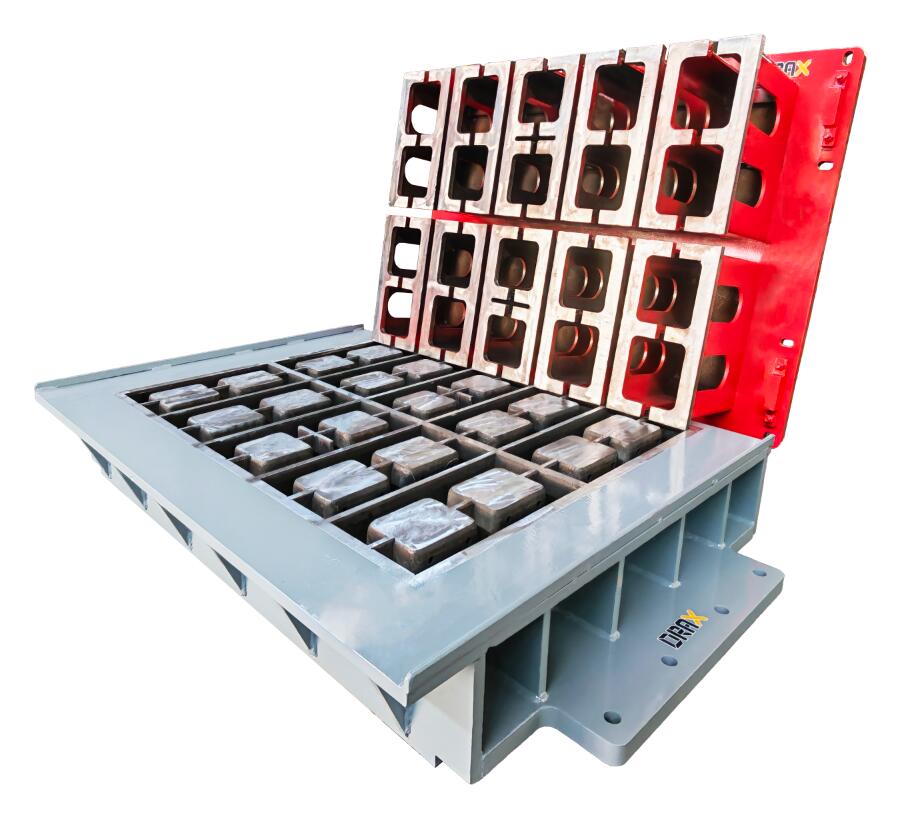
A block mould rarely fails because someone made an obvious mistake. It fails because stress that nobody could see was sitting inside the steel for weeks, sometimes months, before a crack finally shows up at the worst possible time — mid-shift, mid-batch.
What “Stress” Actually Means in a Mould
In simple terms, stress in a mould is internal tension locked inside the steel that has nothing to do with the load the machine is currently applying. It’s left over from how the metal was made, cut, welded, or heat treated — which is why engineers call it residual stress. A mould can be sitting idle on a shelf and still be carrying stress equivalent to a meaningful fraction of the steel’s yield strength. That stress doesn’t show up on a caliper reading. It shows up later, as a crack that seems to appear “out of nowhere” near a bolt hole or a sharp internal corner.
The Stages Where Stress Actually Gets Built In
Most buyers assume stress is purely a production-floor problem — vibration, compaction, repeated impact. That’s only part of the story. Stress accumulates at several distinct points before a mould ever touches a block machine:
Raw steel and rolling. Even mill-supplied plate or bar stock carries some locked-in stress from how it was rolled and cooled at the steel mill, long before it reaches a mould workshop.
CNC machining and wire-EDM cutting. Removing material unevenly — particularly cutting a cavity out of one side of a thick plate — disturbs the internal equilibrium of the steel. The remaining material has to find a new balance, and that redistribution is itself a source of stress, especially around tight internal corners cut by wire-EDM.
Quenching and tempering. This is usually the single largest contributor. Rapid cooling during quenching creates a steep temperature gradient between the surface and the core, and that gradient is what locks stress into the material along with the hardness gain. Tempering afterward is partly there to relieve this, not just to adjust toughness.
Welding the frame. Wherever a cavity insert, baseplate, or reinforcement rib is welded, localized heating and cooling around the weld seam creates a concentrated stress zone in the heat-affected area — one of the more common places a crack starts on a multi-cavity frame.
Cyclic loading in production. Once the mould is running, every compaction cycle adds a small amount of mechanical stress at the same high-load points — pressure-head contact zones, mounting bolts, and sharp internal corners. This is fatigue stress, and it’s cumulative: it builds cycle after cycle rather than appearing all at once.
How Stress Is Actually Detected
On the factory floor, most stress-related problems are caught indirectly rather than measured directly, because true stress measurement requires lab equipment most mould buyers will never own:
- Dimensional drift over time — a cavity that was within tolerance at delivery but starts drifting after a few thousand cycles, without visible wear, often points to stress redistributing itself rather than the surface simply wearing down.
- Warping right after machining — if a plate distorts slightly once a cavity is cut into it, that’s stress that was already present in the raw stock releasing itself the moment the material’s balance was disturbed.
- Hairline cracking near bolts and welds — these are the classic locations where stress concentrates, so a weekly visual check specifically targeting these zones catches most developing problems early.
For a precise reading, manufacturers rely on the hole-drilling method (drilling a small hole and measuring the strain released around it) or X-ray diffraction for surface stress — both standard techniques in tool steel quality control, though neither is something a factory would run on every mould as routine practice.
Can Stress Be Eliminated — And If Not, What’s the Realistic Target?
Complete elimination isn’t the industry benchmark, and chasing it usually isn’t worth the cost. In practice, engineering teams treat a reduction of roughly 50–80% of harmful residual stress as a qualified result, not 100%. The two most common relief methods are:
Stress-relief tempering. A low-temperature heat treatment step (commonly in the 160–375°C range, depending on the steel and the balance of hardness versus toughness desired) performed after quenching specifically to relax the internal stress locked in during rapid cooling, without giving up the hardness gained.
Vibratory stress relief (VSR). For large welded frames where a full furnace treatment isn’t practical, applying controlled vibration at or near the structure’s resonant frequency redistributes and lowers residual stress with almost no dimensional change — a method increasingly used on heavier mould assemblies as an alternative to a second thermal cycle.
When Stress Can’t Be Fully Removed: Designing Around It
Some stress simply can’t be engineered out, especially once a mould is already in service. In those cases, the practical goal shifts from removing stress to keeping it away from the places where it does the most damage:
- Radiused corners instead of sharp 90-degree angles, since sharp internal corners concentrate stress far more than a gently tapered one — this is as much a stress-management decision as a demoulding one.
- Reinforcing known high-stress zones — thicker sections around mounting bolts and pressure-head contact points — rather than uniformly thickening the whole frame.
- Sequencing welds deliberately on multi-cavity frames so heat doesn’t concentrate repeatedly in the same area during assembly.
- Routine inspection focused on the same handful of locations — bolt areas, weld seams, sharp internal corners — instead of a general visual scan, since these are where nearly all stress-related cracking actually starts.
The Practical Takeaway
Stress in a block mould isn’t a single event you can point to — it’s a story that starts at the steel mill and keeps adding chapters through machining, heat treatment, welding, and every production cycle afterward. When you’re evaluating a mould supplier, it’s worth asking directly whether stress-relief tempering is a standard step in their heat treatment process, whether they use vibratory stress relief on larger welded frames, and whether their design already reinforces the corners and bolt zones where cracking typically begins. A mould built with those questions already answered tends to hold its tolerance a lot longer than one that only looks good on the spec sheet.