 Block machine Molds – Brick Machine Moulds Factory

In a modern automated block production line, every production cycle depends on one critical component—the brick machine mould. While operators often focus on the block machine itself, experienced manufacturers know that mould accuracy has a much greater impact on production efficiency, product quality, and equipment uptime.
Even a minor dimensional deviation can be repeated thousands of times per day, resulting in higher rejection rates, increased maintenance, and costly production interruptions.
How Brick Machine Mould Precision Improves Production Efficiency
A precision-engineered brick machine mould ensures that every concrete block or paver is formed consistently during each vibration and pressing cycle.
When cavity dimensions remain accurate, the mould provides:
- Smooth demoulding
- Consistent block height
- Uniform compaction density
- Stable production cycles
- Reduced equipment vibration
By contrast, worn or poorly manufactured moulds often create unnecessary machine stoppages and increase maintenance costs.
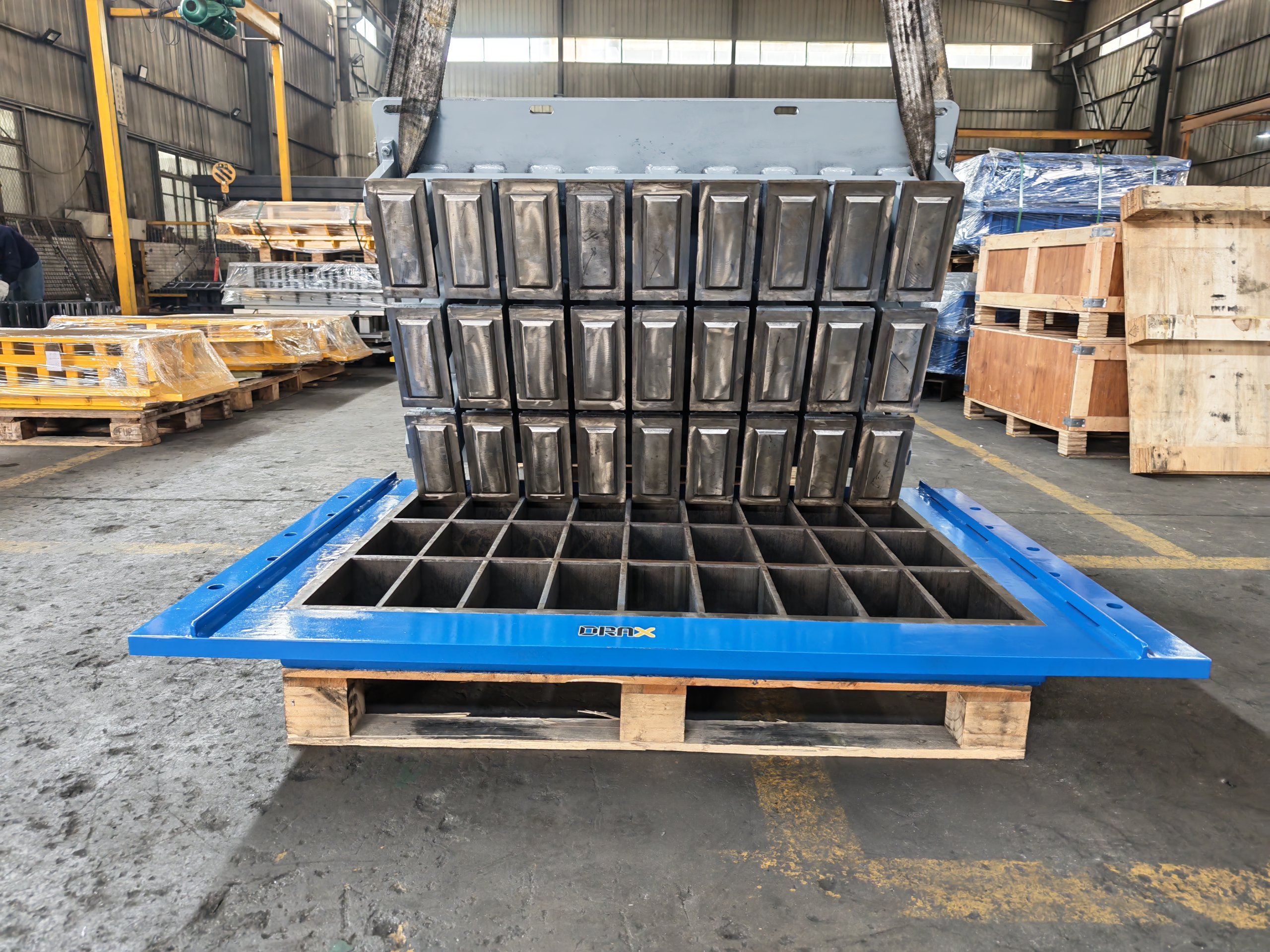
1. Accurate Cavity Tolerances Reduce Demoulding Resistance
The cavity is the heart of every concrete block mould.
Premium mould manufacturers typically machine cavity dimensions within extremely tight tolerances, allowing compaction pressure to be distributed evenly across the entire block.
As mould accuracy gradually decreases, manufacturers commonly experience:
- Higher demoulding resistance
- Inconsistent brick dimensions
- Surface cracks around block corners
- Increased rejected products
Each adjustment requires operators to stop the production line, recalibrate machine settings, and restart production. Although a single adjustment may take only a few minutes, repeated interruptions significantly reduce daily output.
2. Optimized Cavity Geometry Improves Block Release
Precision is not limited to dimensional tolerance alone.
The internal design of a block machine mould—including draft angles, rib geometry, cavity wall thickness, and transition radii—plays an equally important role in production stability.
A scientifically designed cavity allows the freshly compacted concrete block to separate smoothly from the mould, minimizing:
- Edge chipping
- Corner damage
- Surface tearing
- Product deformation
Stable demoulding improves product consistency while reducing downtime caused by rejected blocks.
3. Wear-Resistant Materials Extend Mould Service Life
Even the most accurate mould will eventually wear.
High-quality brick machine moulds typically incorporate hardened tool steel together with advanced surface treatments such as carburizing, nitriding, or other heat-treatment processes to improve wear resistance.
These treatments help maintain cavity accuracy over a much longer production life by reducing:
- Abrasive wear
- Surface deformation
- Loss of dimensional accuracy
- Frequent recalibration
A mould that maintains its precision over millions of production cycles requires fewer maintenance interventions and delivers a lower total cost of ownership.
4. Precision Moulds Improve Overall Production Stability
In high-volume concrete block production, downtime is often caused by small issues that accumulate over time.
A precision mould helps stabilize multiple aspects of production simultaneously, including:
- Consistent vibration performance
- Stable pressing force distribution
- Uniform block dimensions
- Reduced machine adjustments
- Higher daily production output
Instead of reacting to recurring production problems, manufacturers can maintain continuous operation with fewer unexpected stoppages.
How to Evaluate a High-Quality Brick Machine Mould
When selecting a brick machine mould, avoid relying solely on marketing claims such as “high precision” or “long service life.”
Instead, ask suppliers for measurable technical data, including:
- Manufacturing tolerance specifications
- Heat treatment process
- Material grade
- Expected mould service life
- Wear performance under your specific concrete mix
- Recommended production capacity
Reliable suppliers should be able to provide documented performance data rather than generic descriptions.
Conclusion
A precision-engineered brick machine mould is one of the most cost-effective investments for improving automated block production.
Accurate cavity dimensions, optimized geometry, durable materials, and advanced surface treatments work together to reduce downtime, improve block quality, extend mould life, and increase overall production efficiency.
For manufacturers producing concrete blocks, pavers, hollow blocks, or kerbstones, investing in high-quality moulds means fewer production interruptions, lower maintenance costs, and greater long-term profitability.
Frequently Asked Questions
How does a brick machine mould affect production efficiency?
A precision mould ensures smooth demoulding, consistent block dimensions, and stable production cycles, helping reduce downtime and improve overall manufacturing efficiency.
What causes brick machine mould wear?
Continuous vibration, high compaction pressure, abrasive aggregates, and insufficient surface hardness gradually wear the mould cavities, reducing dimensional accuracy over time.
How often should a concrete block mould be replaced?
Service life depends on the mould material, heat treatment, concrete mix, production volume, and machine settings. High-quality moulds typically maintain dimensional accuracy significantly longer than standard tooling.
Why is mould precision important for automated block production?
Even small dimensional errors are repeated thousands of production cycles every day. Maintaining tight tolerances reduces rejected blocks, minimizes machine adjustments, and keeps automated production lines running efficiently.